
Employee Benefits Market Check Survey: Employer Total Well-Being Perspectives
Total well-being (also referred to as wellness) refers to the holistic approach to supporting the overall health and quality of life of employees. It emphasizes physical, financial, emotional/mental, and social health. Employers have been focused on improving the total well-being of their workforce due to its impact on culture, talent attraction and retention, healthcare costs, and productivity.
To gain insights into employer perspective on future well-being strategies, we conducted two polls on September 25 focused on how organizations are approaching initiatives for 2026 and beyond. The following results highlight employer attitudes.
How do you expect your organization’s focus on well-being to change over the next three years?
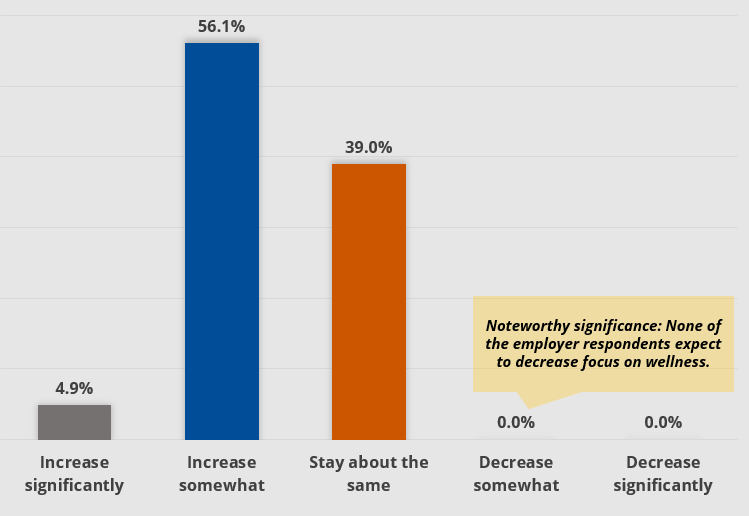
*Results based on 41 employer respondents.
Top Changes to the Well-Being Offering in 2026:
34% Improve communication/education around existing program(s)
10% Add new focus area (e.g. mental health or caregiving)
9% Implement a brand-new offering
8% Change wellness vendor(s)
50% are taking no specific action
*Results based on 163 employer respondents. Respondents could select multiple options; the top four responses are highlighted above.

Key Findings
Many employers are bracing themselves for a difficult renewal season with significant medical cost increases on the horizon. Rising healthcare expenses are forcing challenging choices and may influence how organizations prioritize and allocate resources towards well-being initiatives, from expanding existing programs and introducing new resources to streamlining vendors and adopting emerging technologies. The data above confirms that of the 50% taking some proactive measures, most focused on trying to improve education and communications on what is currently available. A stronger focus on existing programs can help maximize the financial investments already made. Half of the respondents are choosing to take no action.
At the same time, high medical trends are shaping decision-making. Some employers may view well-being as a lever to help manage healthcare costs and reduce claims, while others may scale back offerings to balance their budgets. Fortunately, as of now, employers are not looking to reduce their well-being budget over the next three years. Forward-looking perspectives suggest that well-being will remain a strategic priority overall, with mental health, financial wellness, and technology-enabled solutions expected to see the most growth.
Should you have any questions regarding any of this information or want to discuss your total well-being strategy, please contact your local Assurex Global adviser.


Leave a Reply
Want to join the discussion?Feel free to contribute!