
Employee Benefits Market Check Survey: Family-Building & Non-Traditional Benefits

As employers look for ways to support employees’ diverse needs, family-building and other non-traditional benefits are among the offerings that supplement their benefits packages. From maternity support and adoption assistance to tuition reimbursement programs and cancer support, these offerings can help address employees’ desires beyond traditional health and retirement benefits.
We conducted a survey on October 22 to learn which family-building and other non-traditional benefits employers currently offer. We compared the results with previous years to identify changes in employer offerings over time. The results are summarized below.
Key Findings
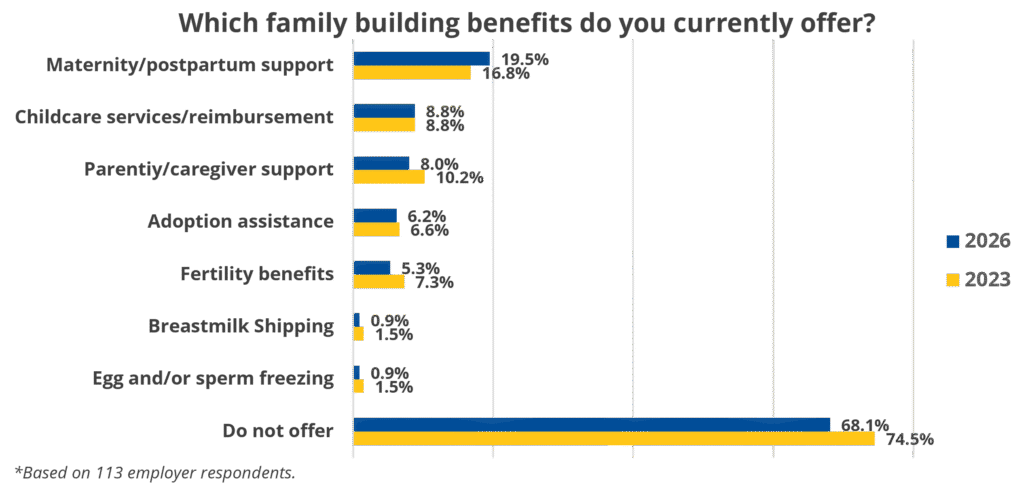
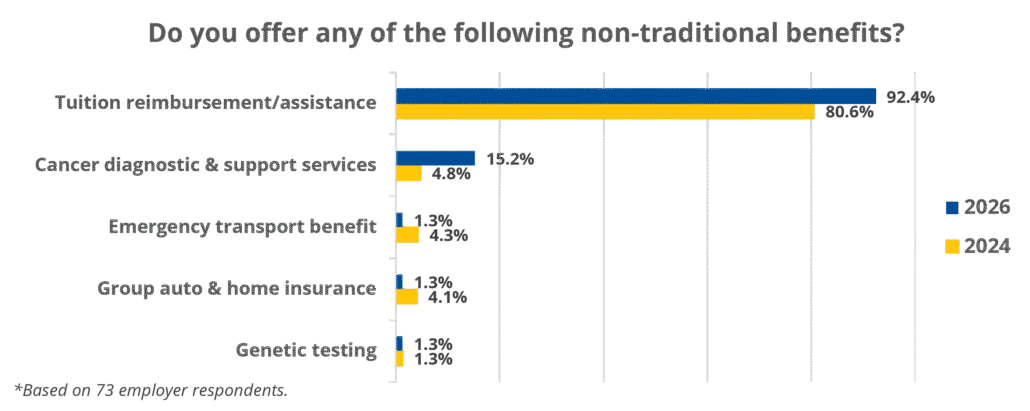
The survey results show that family-building benefits remain relatively uncommon among respondents, with 68% reporting they do not offer any of the listed benefits. Maternity/postpartum support is the most commonly offered family-building benefit, yet only 20% of respondents offer it. Childcare services/reimbursement (9%) and parent/caregiver support (8%) follow. Among non-traditional benefits, tuition reimbursement/assistance stands out, reported by 92% of respondents, while cancer diagnostic and support services were reported by 15%.
Compared with previous survey results, some differences are worth noting. The share of respondents reporting no family building benefits declined from 75% in 2023 to 68% in 2026. For non-traditional benefits, tuition reimbursement/assistance increased from 81% in 2024 to 92% in 2026, while cancer diagnostic and support services increased from 5% to 15%.
When evaluating potential additions to their benefits lineup, employers should consider which offerings are most relevant to their workforce. Employee demographics, family needs, claims data, organizational culture, and available budget can all influence which benefits are likely to provide the greatest value. With rising medical costs consuming significant attention and budget, employers may face competing priorities when deciding where to invest their benefits dollars and focus.
However, expanding the benefits lineup does not always require a significant investment by the employer. Some offerings can be entirely employee-paid, providing access to additional benefits without requiring the employer to fund the coverage. Employers may also be able to implement certain benefits outside their annual enrollment cycle, allowing them to address employee needs without waiting for the next enrollment period.
Rather than adding benefits simply because they are available or gaining attention, employers can evaluate which offerings align with their employees’ needs and their broader benefits strategy. The goal is to build a benefits package that supports the workforce while remaining practical and sustainable for the organization.
Should you have any questions about this information or would like to discuss your benefits strategy, please contact your local Assurex Global adviser.


Leave a Reply
Want to join the discussion?Feel free to contribute!